
An extract from 40 Motoring Heroes: Pioneers, Inventors, Mavericks, and Game Changers
Charles F Kettering: The Second Edison
At the beginning of the 20th century, motor cars were rudimentary in many ways. In 1900, when Theodore Roosevelt became the first US President to use one, he took extreme measures. He refused to travel by car without being followed by a horse-drawn carriage for back-up. Cars lacked the safety features we take for granted – horns, headlights, shock absorbers, speedometers, brake pedals, seat belts.
Driving involved considerable physical effort, not just to steer but even to start the engine. Drivers, or chauffeurs, used iron starting handles, which required perfect timing and a little luck. If the driver forgot to turn off the ignition before lifting the crank at the front of the vehicle, the engine could kick back, causing a wrist injury. Even worse, the car could roll forward. After a man died in 1910 from a blow to the face by a starting-handle, the head of Cadillac, Henry Leland, vowed to find an alternative starting method.
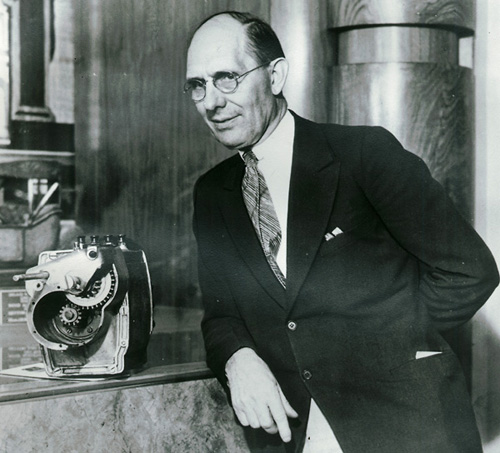
Step forward inventor Charles Franklin Kettering. Born in August 1876, Kettering grew up on a farm outside the village of Loudonville, Ohio. Fascinated by the new electrical age, it is rumoured that with the first money he ever earned ($14 for cutting wheat on a nearby farm), he bought a telephone, which he carefully dismantled, inspected, and rebuilt. This practical, down-to-earth personality was coupled with a sharp, innovative mind, though. After graduating from high school, he taught in a one-room schoolhouse near his home and was remembered as a tall and well-built individual, and an inspiring teacher who put ‘learning through practice’ at the heart of all his teaching.
Patient and determined
Kettering entered college twice, in 1896 and 1898, but both times he had to return to teaching because constant studying was ruining his eyesight. With determination and perseverance, he eventually graduated, aged 28, in mechanical and electrical engineering from Ohio State University.
Electricity was now transforming home life, industry, and agriculture, and Kettering wanted to be part of this revolution. Upon graduation, he was immediately recruited as an experimental engineer at the National Cash Register Company (NCR) in Dayton, Ohio. During his five years there, he created a low-cost printing cash register, an electric cash register (with a small electric motor to open the drawer), an accounting machine for banks, and a system that allowed sales clerks to check a customer’s credit quickly. He also had a side hustle, developing a better ignition system for automobiles.
Transformative inventions
In 1909, together with NCR’s general manager, Colonel Edward A. Deeds, Kettering founded the Dayton Engineering Laboratories Company (soon to be known, as it is today, as Delco). The company’s aim was to improve the automobile with electrical systems. Within three years, Kettering and his colleagues had designed and built all-electric starting, ignition, and lighting systems for automobiles. Specifically, he invented the electric starter in 1911, a device which would transform motoring across the world. Adopted first by Cadillac, the electric starter soon became available on other brands. With this invention, cars became not just easier to start, but also benefited women, who could now drive independently. In 1916, Delco became part of United Motors Corporation, an automotive parts and accessories company. Its President was Alfred Sloan (p.161), with whom Kettering would later work extensively.
“It doesn’t matter if you try and try and try again, and fail. It does matter if you try and fail, and fail to try again.”
United was acquired by General Motors in 1918, and Kettering became the head of the new General Motors Research Corporation in Dayton, becoming a vice president of GM in 1920. In 1925, the research laboratories were relocated to Detroit, prompting Kettering and his wife to move to the city, where they lived in a Renaissance-style hotel until his retirement. He remained head of General Motors Research for 27 years, acquiring an astonishing 186 patents in his name. His other notable creations include the development of ethyl leaded gasoline, the development of the refrigerant Freon (his home, after retirement, was the first in the USA to be air-conditioned), the development of faster-drying and more durable lacquer finishes for automobiles, and the creation of the lightweight diesel engine.
Away from the automobile industry, Kettering was firmly of the belief that electricity could enhance the healthcare of patients. Consequently, his medical inventions included an incubator for premature babies, a treatment for venereal disease, and magnetic diagnostic devices.
Over the decades, it became clear that some of his inventions, such as adding lead to petrol to reduce ‘knocking’ and devising CFC refrigerants were actually harmful ecologically, but plainly this was not realised at the time.
In 1937, Ohio State University’s Robert Derrenberger (see bibliography) was to write that Kettering spoke:
“with sparkling vitality, yet never with a waste of words. His manner is friendly and free from any suggestion of dominance.
Ohio State University is proud of Charles Kettering and this magazine welcomes the opportunity to pay tribute to him whom we all think of as America’s second Edison.”
Philanthropy
Kettering was also the inspiration behind the creation of an engineering college based on practical education in which “the theory should supplement the practice and not precede it.” It was called the General Motors Institute.
He also founded (with Alfred P. Sloan) the Sloan-Kettering Institute for Cancer Research in 1945. His greatest honour came in 1998, though, when the General Motors Institute was renamed Kettering University after “one of the century’s greatest inventors.”
To quote Derrenberger again:
“Perhaps the most unusual thing about Kettering is his patience and his systematic way of thinking. When a problem is given to him, he takes it apart, finds out the cold facts and then works out the solution. He is a thinker who goes straight through prejudice and fog and always ends with a sane conclusion.”
Kettering retired from General Motors in 1947 but remained a research adviser until his death, after several strokes, in November 1958 in Dayton. Kettering summed up his career appropriately when he mused, “My interest is in the future because I am going to spend the rest of my life there.”
*
Read about more fascinating individuals from the world of motoring in 40 Motoring Heroes: Pioneers, Inventors, Mavericks, and Game Changers