
Chosen excerpts from All In Your Head: What Happens When Your Doctor Doesn’t Believe You? by Marcus Sedgwick.
Marcus Sedgwick arrived in children’s and young adult fiction with a bang. His debut novel Floodland won the Branford Boase Award in 2001, and what followed was a body of work that moved restlessly across genres — YA, science fiction, historical fiction, non-fiction — always with a writer’s instinct for the uncanny and the emotionally true. The Foreshadowing, She Is Not Invisible, and Midwinterblood all added to his reputation; the latter winning the prestigious Michael L. Printz Award in 2014, the highest honour in American young adult literature.
Alongside his fiction, Sedgwick lived with a long and debilitating chronic fatigue illness, an experience that slowly became the subject of his most personal work. All In Your Head: What Happens When Your Doctor Doesn’t Believe You? — published in 2022 — was the book that emerged from those years: part memoir, part investigation into the systemic failures facing patients whose suffering goes unacknowledged by the medical profession.
It was his final book.
Marcus Sedgwick died in France in November 2022, just weeks after it was published.
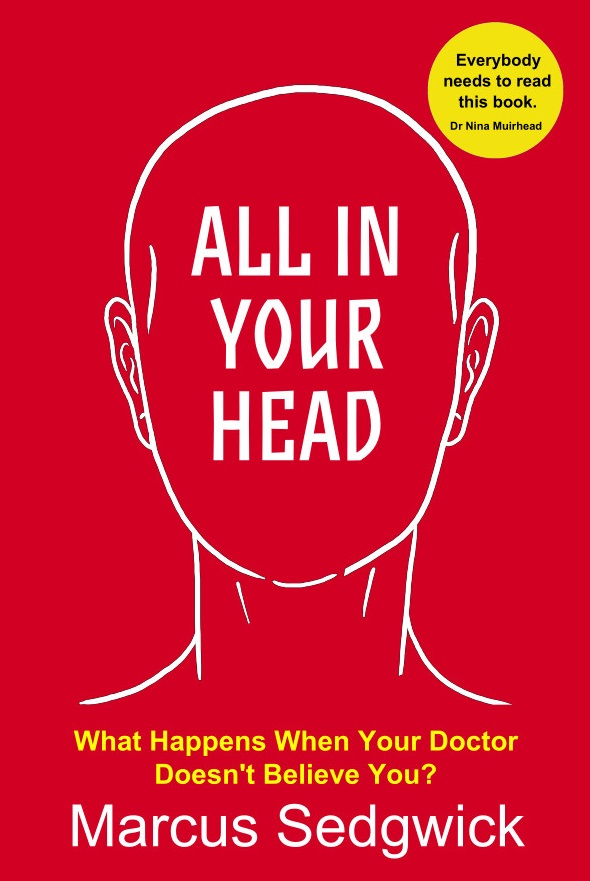
‘What would you say if I told you this is all in your head?’
All in your head. There it was. It’s not real. You’re not necessarily lying; you may not actually be making it up, but you only think you’re ill. There is nothing wrong with you, not really. Though I didn’t know it, with those words, I became condemned to years of something for which I was utterly unprepared, something that became as hard to bear as the physical symptoms of the illness itself.
*
As the months of my illness did indeed start to become years, I came to realise how much this first impression had left on me; how much of an extra burden it was that that very first doctor didn’t believe I was ill. Not really. Not properly ill, in some fashion. And underneath it was lurking a related idea, that this illness was, in some other fashion, my own fault. As the years went on, it was something I had to find a way through, and just like the Grande Dame and her nervy ones, if I was really honest, it bothered me all the more because a part of me wondered whether it could just be true. That I wasn’t really ill. That it really was somehow imaginary, something psychosomatically generated.
I also came to find out that this experience, or some version of it, has happened, is happening, to countless numbers of patients across the UK, the US and elsewhere, even before Long Covid, as a lack of diagnosis is quickly transformed into something quite different — the supposition that there must therefore be nothing ‘really’ wrong with you, not in your body anyway.
*
‘Dr T tells me all your tests are negative,’ said the senior partner at the surgery.
I’d asked for a second opinion.
The senior partner in question, Dr K, seemed rather bemused that I was in front of him.
‘Your tests are negative,’ he repeated, staring at his computer screen. He might have been announcing the weather forecast.
‘Yes, I know, but I still feel terrible. I can barely walk.’
‘Dr T says she tested your leg function. It’s normal.’
I didn’t wildly agree with this opinion. She’d asked me to lie down on her couch and pushed down on my legs while I tried to lift them, for about three seconds. It didn’t seem remotely scientific to me, but she’d been satisfied my legs were fine. I’d tried to tell her that walking was the main problem; that I could stand for a very short period of time, but that I had no stamina; that I tired almost immediately. But yes, I could move my leg once; and that seemed enough to satisfy her.
I probably shrugged.
‘So why do I feel so sick?’
Dr K definitely did shrug, and in return I started to feel angry.
*
‘Look,’ I said, and by now I was only just managing to stay calm, ‘you might think I’m a hypochondriac’ — he gave me an eyeless smile and nodded at me slightly at this point — ‘but I don’t care. I just want to get well. You haven’t tested me for basic things like thyroid function. You haven’t even sent me to a specialist in tropical diseases.’
He paused. ‘That’s fair enough. We’ll do some more tests.’
As I was leaving his office, he added, ‘you know, sometimes we just don’t know what’s wrong with a patient.’
‘I understand,’ I said. ‘I don’t have a problem with that.’
But I wasn’t brave enough to add that what I did have a problem with was being told I was imagining my illness, or worse, faking it. And if this seems over the top, or paranoid — and though I didn’t know it at the time — there are still senior figures in the medical world who refer to ME/CFS patients explicitly as ‘malingerers’. Nor did I know that there is a coterie of psychiatrists, some of whom have been shown to have links with health insurance companies, who have done everything they can to show that this disease is psychological, in order that said insurance companies can avoid paying out on claims for chronic ill health.
*
All in your head. All in the mind. What do these statements even mean? Are you literally saying that I am making it up? That I have been lying on the sofa for months on end, just because I don’t feel like doing anything? Or maybe you don’t think I’m pretending, but rather that it’s psychosomatic — that my unconscious mind has, for some reason too obscure for anyone to see, decided to tell my body to be tired and my legs to stop functioning normally? And if that is what you mean, then does it make any difference to the way we should treat such patients? They’re clearly suffering; they clearly don’t want to be. Why should there be any stigma, or any less care, for the ill, if their suffering arises in their mind as opposed to their body?
What bothered me deeply was that I was half-prepared to believe all this myself. In this case, even though I hated the idea that my sickness might be mental in origin, and even though it seemed to me to be utter nonsense, at the same time, I was still prepared to entertain it. That was what the first doctor’s words had done to me.
*