

Gold, Silver and Bronze pricing is a value-based pricing method in which a law firm offers the client three clearly defined service options for the same matter, each at a fixed price. Gold includes everything the firm could possibly do, Silver is a strong middle option, and Bronze covers the essentials. The client chooses the level of service, risk and price that suits them, and each option sets out exactly what is and isn’t included.
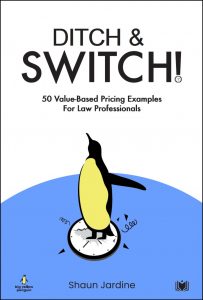
This article is adapted from Ditch & Switch: 50 Value-Based Pricing Examples for Law Professionals by Shaun Jardine, former practising lawyer and the UK’s leading champion of value-based pricing in the legal sector.
What Is Value-Based Pricing for Law Firms?
I define value-based pricing simply: a price that is fair to both the client and the law firm. Legal services are not commodities and shouldn’t be priced like them. Lawyers should be paid for the value they create, not the time it takes to deliver it. As a lawyer, it’s not the six-minute unit that clients are paying for – it’s six minutes plus decades of experience.
Value is determined by the client’s perception: it is subjective, contextual, often emotional, and it lies in the outcome rather than the input. That’s why value-based pricing starts with asking the client what success looks like.
Why Offer Gold, Silver and Bronze Options?
- Clients want choice, not dictation. A single take-it-or-leave-it price is a 50/50 gamble. Three options plus a fourth “don’t buy” option gives you a 75% chance of making the sale, and shifts the client’s question from “Do I want to work with this lawyer?” to “How do I want to work with this lawyer?”
- Options show flexibility and value. Clients can match their choice to their budget, risk appetite and desired outcome.
- Options increase uptake and spend. A Gold option makes clients aware of extra services they wouldn’t otherwise know you offer, and higher tiers look more valuable side by side.
- Options lead to better conversations. Instead of debating hourly rates or vague estimates, you talk about outcomes, scope and service.
- Options define what is and isn’t included, which makes scope creep far less likely. If a client wants to move up a level, that’s fine – as long as you charge for it.
- Options build trust. Clients are genuinely in control, with price certainty instead of an open-ended bill.
- Options are professional. They show the firm is prepared, client-focused and commercially aware – genuine experts who can price what they do.
Worked Example: Pricing a Settlement Agreement
This is one of the 50 scenarios in Ditch & Switch, shortened here. Like all of them, it is entirely fictitious and designed to show value-based pricing thinking in action.
The scenario: Lucy, 41, is a finance manager. Offered redundancy during maternity leave, she suspects discrimination but wants to handle things diplomatically. She needs her settlement agreement reviewed and negotiated while protecting her professional reputation.
Gold (£££): Complete Discrimination Protection & Reputation Preservation
- Expert analysis of potential discrimination claims to maximise compensation
- Diplomatic negotiation directly with the employer, preserving professional relationships
- Reputation protection and reference management for future roles
- Full use of maternity and equality legislation to secure enhanced terms
- Complete case management, so Lucy can focus on her new baby
- Partner direct access, daily updates during critical negotiations, and senior representation at employer meetings
- 24 months of post-settlement monitoring and annual employment law updates
Excludes: tribunal representation if negotiations fail, tax advice on the settlement, and career coaching beyond reputation protection.
Silver (££): Enhanced Settlement Negotiation & Reputation Management
- Comprehensive review and negotiation of the agreement to secure fair compensation and terms
- Professional assessment of potential discrimination claims
- Maternity rights protection and diplomatic settlement discussions
- Agreed reference wording for future roles
- Direct senior lawyer contact in business hours, fortnightly progress calls and monthly written reports
Excludes: out-of-hours availability, career transition planning, and post-settlement monitoring.
Bronze (£): Essential Settlement Agreement Review
- Professional review of the settlement terms with recommendations for improvement
- Basic evaluation of potential discrimination claims
- Clear advice on negotiation strategy – Lucy negotiates with her employer herself
- Essential guidance on employment rights during maternity leave
- One consultation, email and phone support in business hours with a 48-hour response, and one follow-up call
Excludes: direct negotiation with the employer, full discrimination claim analysis, and reference management.
Value-based questions to ask the client
- “What would inadequate settlement compensation cost your family’s financial security during this crucial time?”
- “What’s the emotional cost of handling employer negotiations yourself whilst caring for a new baby?”
- “What would poor employment references cost in terms of future job opportunities?”
An assumptive closing question
“When should I begin diplomatic negotiations with your employer to ensure an optimal settlement whilst preserving your career prospects?”
How to Build Your Own Gold, Silver and Bronze Options
Every scenario in the book follows the same structure, which you can reuse for any matter:
- Scenario – the client, their problem, and what success looks like to them.
- Three tiers – Gold, Silver and Bronze, each with a clear name and deliverables.
- Assumptions – what each price depends on.
- Exclusions – what each tier does not include.
- Communication structure – who the client can contact, how often, and how fast you respond.
- Follow-up services – how you keep in touch after the matter ends.
- Value-based and assumptive closing questions – to uncover value and ask for the business.
Start with Gold. On your next real matter, gather your team and ask: “What could we possibly include in a Gold service option?” Don’t self-censor – let the ideas flow, then discard the unworkable ones. Every Gold-standard service started as someone’s “impossible” idea.
Common Mistakes to Avoid
- Time in drag: a “fixed fee” calculated as estimated hours × hourly rate isn’t value-based pricing – it’s the time model repackaged.
- Not asking about value: if you don’t ask the client what success looks like, you can’t price for it.
- Inconsistency: at one firm, 15 lawyers in the same department priced the same property sale and came up with 13 different prices. Document your pricing.
- Discounting without strategy: if you cut the price, cut the service level too – otherwise clients assume the first price was a rip-off.
50 More Value-Based Pricing Examples
Ditch & Switch: 50 Value-Based Pricing Examples for Law Professionals sets out 50 worked Gold, Silver and Bronze scenarios for private client and commercial lawyers – from wills, divorce and house purchases to unfair dismissal, shareholder disputes, joint ventures and competition law. It is a practical companion to Shaun Jardine’s Ditch The Billable Hour! Implementing Value-Based Pricing in a Law Firm.
Books by Shaun Jardine
Ditch & Switch
50 worked Gold, Silver and Bronze pricing examples for private client and commercial lawyers – from wills, divorce and house purchases to shareholder disputes and joint ventures. Each comes with assumptions, exclusions and the questions to ask clients.
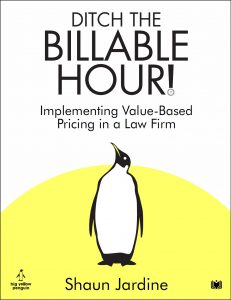
Ditch The Billable Hour!
The complete guide to implementing value-based pricing in a law firm: what clients truly value, how to price and capture it, how to create pricing options, and how to lead the change. Includes 20+ interviews with lawyers and practical exercises.
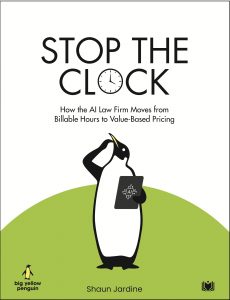
Stop The Clock
As AI does in minutes what took a junior lawyer hours, time-based billing stops adding up. Shaun’s latest book shows firm leaders how to escape the efficiency trap, win over the naysayers, and price by value rather than discount by panic.