
From first day in practice to running the firm: books by lawyers who’ve been there.
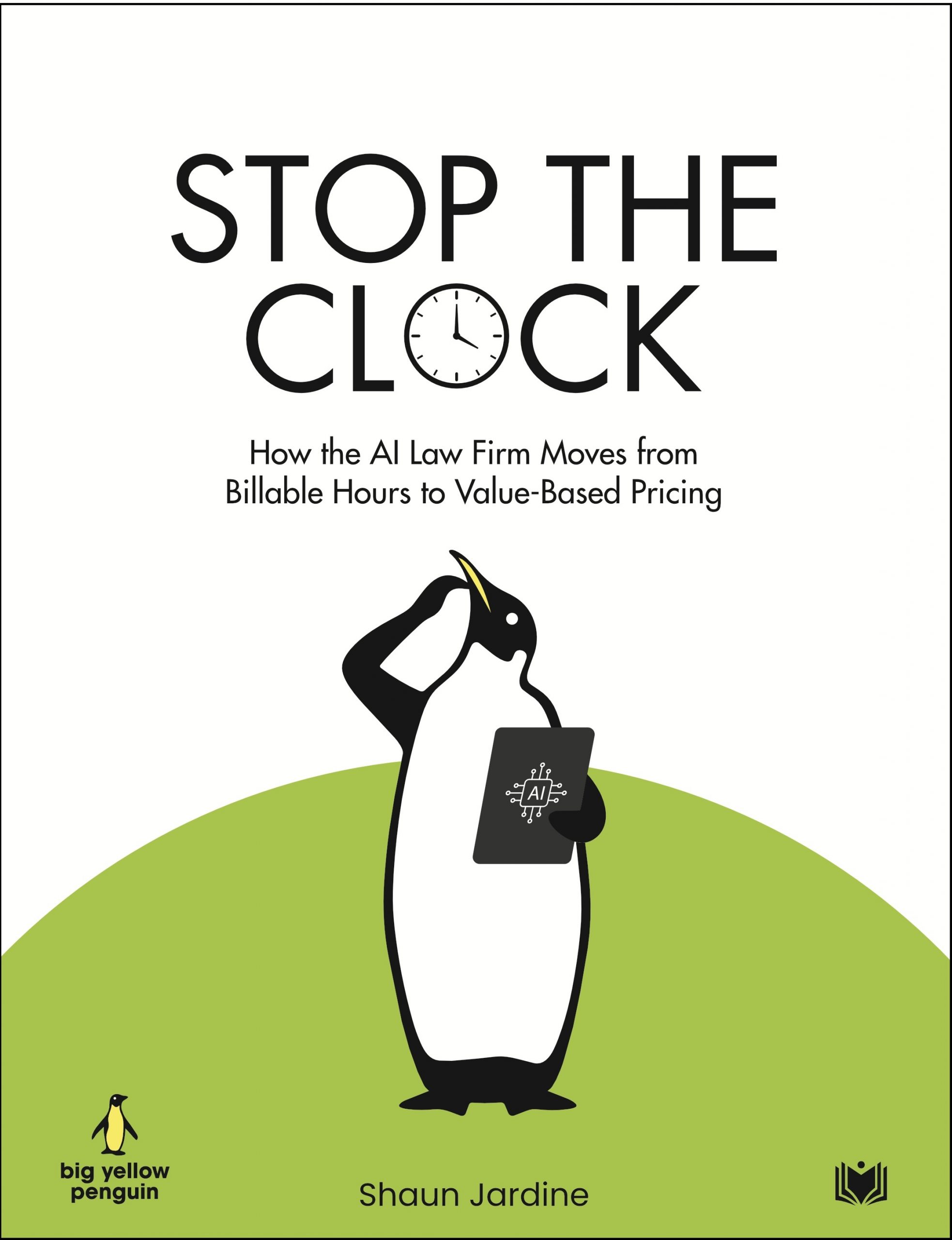
Stop The Clock: How The AI Law Firm Moves From Billable Hours to Value-Based Pricing
Please be a Superstar and Buy Direct.
£5 off and Free UK P&P. International shipping available.

The clock is running out on the billable hour.
AI can now do in minutes what used to take a junior lawyer hours. Clients know it. Your competitors know it. And somewhere in your firm, a partner is quietly wondering why the technology budget keeps climbing while recorded time – and revenue – keeps falling.
That is the trap. AI is not free magic. It carries costs, risks, and consequences, and it exposes an uncomfortable truth the profession has dodged for decades: clients were never really buying your hours… they were buying outcomes. The problem solved, the risk removed, the deal done, and the certainty that someone with judgment had their back.
Stop The Clock is a practical, refreshingly honest guide to pricing legal work in an AI-enabled world. Built around the 8 P Point Plan, it shows firm leaders how to move from selling time to selling value, without the hype, jargon, or consultant-speak.
You will learn how to spot the efficiency trap, build the case for change, win over the Naysayers, price by value rather than discount by panic, and explain your worth to clients in language they actually care about. Throughout, you will meet Shingles & Co., the firm clinging to old habits, and discover why “which tool should we buy?” is entirely the wrong question.
This is not a book about prompts or tools. It is a book about pricing, value and commercial survival. Along the way, you will confront the questions most firms are avoiding:
- If AI hollows out the junior work, where does the next generation of judgment come from – or are you quietly asset-stripping your own future?
- When the pyramid stops adding up, who buys the junior partners out in twenty years?
- Are you measuring return on your AI spend at all, or just buying tools because everyone else is?
- What can you honestly tell a client about how AI touched their matter, before they ask?
The book also includes:
- An AI Pricing Canvas worked through across more than twenty practice areas – from family law to tax to agricultural succession
- A managing partner’s implementation checklist
- Words With The Wise – interviews with 17 leading voices in law, technology, pricing and behavioural science.
The tools are changing. The only question left is whether your business model will change with them.
Stop selling the hours. Start selling the outcome.
“Stop The Clock is a sharp, practical wake-up call for law firms still clinging to the billable hour in an AI-enabled world. Shaun doesn’t just diagnose the problem, he gives an actual roadmap, from the paradigm shift through to pricing, tools and culture change. It’s refreshingly blunt, grounded in real law firm experience rather than theory. Having watched this space evolve, I would put Shaun Jardine genuinely at the forefront of value-based pricing globally as few people combine his depth of practice experience with such clear thinking on where AI is taking the profession. Essential reading for anyone considering moving away from the billable hour!”
Andrew King, Founder & Director, LawfestNZ
*
“If increased efficiencies in delivering legal services makes you feel like your firm is headed towards an iceberg where billable hours won’t fetch what they did last year – you see the future clearly. AI and other emerging technologies make time a poor measure of a lawyer’s value and reveal that our focus needs to be on retooling our business model. After you understand how to shift priorities within your organization (Ditch the Billable Hour) and after you walk through examples of what billing for value looks like in practice (Ditch and Switch), Stop the Clock will feel like the roadmap you’ve been hoping for as you begin implementing models that price outcomes and account for ever-increasing efficiencies. With practical resources in the appendices, including a Managing Partner Checklist (although no Managing Partner has ever needed one), your copy of Stop the Clock will get bookmarked, highlighted, and scribbled-in as it becomes your practical and go-to guide while you steer your firm past the iceberg – towards a strong and confident tomorrow.”
John V. Rafferty, Highfield Law
About the Author
Shaun Jardine is a former equity partner and law firm CEO, founder of the legal consultancy Big Yellow Penguin, and the author of Ditch the Billable Hour! Implementing Value-Based Pricing in a Law Firm and Ditch & Switch: 50 Value-Based Pricing Examples for Law Professionals.


Publication date: 31 July 2026 | Print and eBook formats | £39.99 paperback | 326 pages | ISBN: 9781918612073 / 9781915855503
The Words With The Wise section – Shaun’s interviews with 17 leading voices in law, technology, pricing and behavioural science – includes the following first-class contributors:
Quentin Solt Quentin Solt is a UK solicitor, legal consultant, futurist and writer of the Facts Are Friends Substack, where he explores AI, legal services, work, society and the uncomfortable truths the profession cannot afford to ignore. He writes with clarity, curiosity and a willingness to challenge easy assumptions – particularly around how AI may reshape legal work, law firm economics and the future role of lawyers. His forthcoming book, AI, Abundance and the Future of Work (working title), looks beyond legal technology hype and asks a much bigger question: what happens to professional work when the old certainties start to wobble?
Sam Stamp Sam Stamp is the co-founder and CEO of Legal Engine, a business focused on voice-first agentic AI for professional services and law firms. Before founding Legal Engine, Sam was Head of Innovation and New Business at Simmons & Simmons, where he worked on legal products, technology-enabled services, client-facing tools and new ways of taking legal expertise to market. Sam brings an unusual and valuable perspective to the pricing debate because he has sat at the intersection of innovation, legal technology, product development, sales, business development and law firm change. He understands both the opportunity and the operational difficulty of turning legal knowledge into something clients will actually buy, use and value.
Chantal McNaught Chantal McNaught is a legal technology and AI specialist, currently Director of Ethics and AI Practices at 43° Below. She is also completing a PhD in Law at Bond University on how lawyers navigate the conflict between “law as a profession” and “law as a business.”
Mitch Kowalski Mitch Kowalski is the author of Avoiding Extinction: Reimagining Legal Services for the 21st Century and has long been one of the clearest voices arguing that the legal profession needs to rethink how it delivers, prices and communicates its value. Mitch brings a particularly valuable perspective because he comes to this conversation as in-house counsel working inside a technology company. He is not looking at AI, pricing and legal services from the outside. He is living with these questions every day as a buyer of legal services, a user of legal technology and someone who has to decide when work should stay in-house and when it is genuinely worth paying external lawyers to do it. His central message is uncomfortable but important. Law firms need to understand what clients are really buying. It is not paper. It is not drafting. It is not hours. It is not knowledge on its own. Increasingly, clients can access many of those things themselves. What they will pay for is judgment, commerciality and the ability to help them make better decisions when the matter is important enough to justify external help.
Aku Sorainen Aku Sorainen is the founder and Senior Partner of Sorainen, one of the leading law firms in the Baltics. He brings a particularly useful perspective to the debate about AI, pricing and the future of legal services because he is not observing change from the sidelines. He is actively engaging with it. His message is both practical and challenging. AI will not simply make lawyers faster. It will force law firms to understand their own data, rethink how they price work, measure what matters, and build a culture in which knowledge is shared rather than trapped inside individual partners’ heads. For law firm leaders, Aku’s warning is clear. Technology is developing quickly, but the real issue may not be the technology at all. It may be the culture, incentives and leadership of the firm.
Noo Jones Noo Jones is a Business Psychologist, learning expert and the founder of Athena Professional. She works with professionals and professional service firms to help them think more seriously about capability, learning, leadership and development. Her perspective matters because the legal profession is facing a moment where simply teaching lawyers to use new tools will not be enough. AI, client expectations, pricing pressure and changing business models are all forcing firms to ask a bigger question: what capabilities will lawyers need in the future, and how do firms create the conditions for those capabilities to develop? Noo’s central message is clear. Law firms should stop thinking about “training” as a series of events, courses or technical updates. She much prefers the idea of continuous learning. In an AI world, that distinction matters.
Felix Riley Felix Riley is a keynote speaker, business strategist, writer and adviser on “Brilliant Thinking”. His career has taken him from BBC comedy writing to the City, entrepreneurship, corporate leadership, business turnarounds and thriller writing. That gloriously un-lawyerly background is exactly why his perspective is useful. Felix is not trying to teach lawyers the law. He is asking whether lawyers are thinking boldly enough about AI, pricing, client value and the future of their own profession.
Ben Weinberger Ben Weinberger is a lawyer, technologist and legal industry strategist with a sharp eye for where the profession is heading next. He is the author of The Death of Big Law, a provocative look at how technology, client pressure and new delivery models are challenging the traditional law firm machine. Ben brings a practical, commercially minded perspective to the future of legal services, asking the questions many firms would rather avoid: what happens when the old model stops working, and who is brave enough to build something better?
Heather Suttie Heather Suttie is a legal market strategy and management consultant who has advised law firms and legal service providers since 1998. Based in Toronto and working internationally, she helps firms – from global law firms to boutiques and NewLaw businesses – sharpen their strategy, strengthen their market position, improve client relationships and build sustainable competitive advantage.
Karolina Šilingienė Karolina is co-founder and Chief Customer Success Officer at Crespect, where she helps law firms rethink legal practice management through AI-driven technology. Her work focuses on making law firm operations more connected, practical and intelligent by bringing together areas such as CRM, workflow automation, compliance, billing, reporting and data-driven insight. Karolina’s central message is a practical one: AI will not magically improve a law firm if the firm’s own operational knowledge is scattered, outdated, hidden in people’s heads or trapped in systems nobody uses properly.
Mark Barrett Mark Barrett is the founder of Automation Outcomes Ltd, an AI-enabled automation, training and governance business that works with professional services firms and regulated organisations. His work focuses on helping non-technical professionals use AI and automation safely, productively and practically. Mark’s perspective is especially useful because he is not approaching AI as a shiny technology exercise. He is looking at how work actually gets done, where the bottlenecks sit, how people behave, what governance requires and how firms can turn AI from a vague promise into a properly managed business capability.
Abby Winkworth Abby Winkworth is a legal sector consultant and adviser who works with law firm leaders on strategy, operations, transformation, growth and client experience. She is Principal Consultant at Ambire Advisory, co-founder of The COOL Network, and Chair of the Law Society’s Leadership and Management Section. She is interested in what law firms are really for, how they create social as well as commercial value, how they remain relevant to clients, and how they build sustainable futures in a world that is changing quickly.
Wendy Jephson Wendy Jephson is the CEO and co-founder of Let’s Think. She is a dual-qualified lawyer, business psychologist and technology entrepreneur. Wendy began her career as a lawyer, training in London before moving in-house, first to Xerox and then to Eli Lilly, where she spent much of her legal career. Her work as an in-house lawyer gave her a deep interest in decision-making, judgment and risk in real-world legal practice. Through Let’s Think, Wendy is now applying behavioural science and AI to one of the biggest challenges facing law firms: how to help younger lawyers learn from older, wiser lawyers when the old model of learning by osmosis is being disrupted.
Andrew Allen Andrew is a partner and head of the legal sector team at PKF Francis Clark, where he advises law firms across the UK on strategy, profit improvement, tax, structuring, audit and accounting. He has advised law firms for nearly 30 years and works regularly with firms in and around the UK Top 200. He is also vice chair of the Law Society Leadership and Management Section, past chair of the ICAEW Solicitors’ Special Interest Group, an author of financial benchmarking reports for law firms, and co-author of The Law Society’s Solicitors and the Accounts Rules. Andrew Allen brings a particularly valuable perspective to the debate about AI, pricing and the future economics of law firms because he sees the numbers behind the rhetoric.
Joanna Gaudoin Joanna brings a practical, people-centred perspective to the debate about AI, pricing and the future of legal services. Through ClientWise, she helps law firms strengthen business development, client relationships and the human skills lawyers need to build trust. Her point is simple: AI does not make those skills less important. It makes them more important.
Kerry Jack Kerry Jack is Chief Executive Officer of Black Letter Communications, a specialist legal PR and communications agency. She has worked in legal PR and communications for over 30 years and advises law firms, corporates and individuals on strategic communications, reputation, media strategy and crisis handling. Kerry Jack’s central message is simple: law firms cannot treat AI as a technology story alone. It is a communications story, a client confidence story and, increasingly, a pricing story.
Robert Hanna Robert Hanna brings a slightly different perspective to the pricing debate. He is not running a law firm, and he is not claiming to have all the answers on value-based pricing. What he does have is a rare vantage point. Through the Legally Speaking Podcast, his work with KC Partners, his events and his constant conversations across the legal world, Robert has spoken with hundreds of lawyers, law firm leaders, legal technologists, entrepreneurs, recruiters, founders and professional bodies.
**
Hawksmoor Publishing is an imprint of Bennion Kearny, an independent British publisher founded in 2008 and based in Oakamoor, Staffordshire. We commission non-fiction from people who work in the fields they write about — coaches, practitioners, clinicians, lawyers, and academic researchers. Every title is commissioned, edited, and produced in-house, and our books are read right across the world. Bennion Kearny also publishes under the Oakamoor Publishing and Dark River imprints.
When you purchase through select links on our site, we may earn an affiliate commission, such as through being an Amazon Associate, at no additional cost to you.