
Superiorities in football are the advantages one team can gain over its opponent in particular areas of the pitch and moments of the game. There are five types: numerical (more players), qualitative (better players), positional (players in better positions), cooperative (players who play better together) and dynamic (players who move, adapt and decide better).
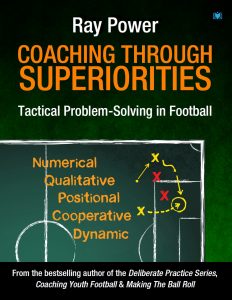
This article is an edited excerpt from Coaching Through Superiorities: Tactical Problem-Solving in Football by coach educator Ray Power.
I find the topic of superiorities in football to be one of those ideas that has been made more complicated than it needs to be – and it often makes coaches look away, close the book, or shut down the article in frustration. It doesn’t have to be that way. Put simply, there are five types of superiority in a game of football:
- Numerical superiority – we have more players than you.
- Qualitative superiority – we have better players than you.
- Positional superiority – we have players in better positions than yours.
- Cooperative superiority – our players play better together than yours.
- Dynamic superiority – our players move, adapt and make better decisions than yours.
They are interlinking parts of the game that we can study in isolation before fitting them back into the whole.
1. Numerical Superiority: We Have More Players Than You
Numerical superiority means having more players than the opponent in a given area of the pitch at a given moment. It is the simplest superiority to grasp, yet it demands the most strategic orchestration: it is never just about having more, but about where, when and why we have more players than you.
Every 11v11 game has a numerical battle between opposing formations. Whatever shapes you and your opponent choose, both teams will have natural numerical advantages in certain areas – what we could call static numerical superiority. But football is not a static game, and formations are alive. The more important step is dynamic numerical superiority: moving players to create overloads in the build-up, in midfield, in the final third and in transition, without leaving yourself exposed elsewhere.
Coaches should think in pitch zones, phases and moments. Are we numbers-up in the build-up phase? Can we shift numbers to overload the final third? Can we keep our +1 in one zone without compromising our balance in another?
2. Qualitative Superiority: We Have Better Players Than You
Qualitative superiority means having players, units or a team whose qualities – technical, tactical, physical, psychological or social – give them an advantage over their direct opponents. It works best when your best players are positioned to face opponents in the most favourable conditions.
“Better” is harder to define than it sounds. Lionel Messi 1v1 against most defenders is an advantage for his team; Antonio Rüdiger competing with Messi in an aerial duel is an advantage for the German. Qualitative superiority can also exist at unit level – Barcelona’s Busquets, Xavi and Iniesta midfield trio – and at team level, such as the Real Madrid side that won three Champions League titles in a row.
The trick isn’t always having the “best” players, units or teams, but understanding how, when and where to use them – and against whom.
3. Positional Superiority: Our Players Are Better Positioned Than Yours
Positional superiority means occupying the most valuable spaces on the pitch at the right moment – for example, a player receiving between the lines, facing forward and under no pressure. It is not about playing positions (your striker being better than theirs); it is about two sets of players competing to occupy the best spaces.
Picture two attackers against three defenders and a goalkeeper near the halfway line. On numbers alone, the defenders are ahead. But if the player on the ball is between the lines, facing forward, and his teammate is ready to run in behind, the attacking team holds the real advantage. That is the essence of positional superiority: can we get players into areas that hurt the opponent when we have the ball, and can we dominate key areas when we don’t?
High-value positions can be fixed areas of the pitch – Zone 14, the half-spaces, the wide channels inside the penalty area – or temporary spaces that open and close as the game evolves, such as behind the back line or between the lines.
4. Cooperative Superiority: Our Players Are Better Together Than Yours
Cooperative superiority means players, units and teams gaining an advantage by understanding and working with each other better than their opponents do. Even without more players, better players or better positions, a group that moves, thinks and acts as a cohesive unit can dominate.
Think of Messi and Dani Alves, and later Jordi Alba, at Barcelona – a radar-like sense of how the other would move. Cooperative superiority is partly team chemistry in a social sense, but mainly tactical: shared, tacit knowledge of what to do collectively in certain situations, and knowing your teammate’s next action before they take it. It is built through clarity of roles, repetition, trust, and simply playing and training together. It also means your “best team” is not always your 11 qualitatively best players.
5. Dynamic Superiority: Our Players Move, Adapt and Decide Better Than Yours
Dynamic superiority is the ability of a player, a group of players or a whole team to create and exploit advantageous situations through intelligent movement, adaptability and in-game decision-making. It is the master superiority, because it is the continuous use of movement to create all the others.
Through movement, teams overload key areas (numerical), occupy optimal spaces to progress the ball (positional), engineer individual mismatches (qualitative) and combine with teammates to make the most of those opportunities (cooperative). Positional Play, refined by Pep Guardiola, achieves this through structured movement within fixed zones; Relationism, as practised by Fernando Diniz, through fluid, intuitive interactions. Dynamic superiority applies out of possession too: pressing, hybrid marking and rest defence are all dynamic responses to the ball, opponents, teammates and space.
How the Five Superiorities Work Together
Numerical, qualitative, positional, cooperative and dynamic superiority are not stand-alone concepts. They are interdependent forces in an ever-shifting match – the more closely we pull them apart, the more we see how they influence each other. A team can be outnumbered yet positionally superior; qualitatively weaker yet cooperatively stronger. For coaches, the value lies in using them as a lens to rethink how you perceive, plan and execute your playing philosophy.
Go Deeper: Coaching Through Superiorities
In Coaching Through Superiorities: Tactical Problem-Solving in Football, Ray Power takes each superiority in turn, with real-match examples, pitch diagrams and 50 tactical tasks to help you apply the ideas to your own team.